
Supporting the Shift — and Why Consistency Changes Everything

Making the decision to wash less is often the easiest part.
Understanding why it matters brings clarity. Acting on that understanding requires resolve. What follows, however, is where most people begin to doubt themselves — not because something has gone wrong, but because the body has begun to respond.
In our January Journal, The Ritual of Less: Why Washing Less Supports Stronger, Healthier Hair, we explored how reducing wash frequency allows the scalp and hair to restore balance, strengthen the hair fibre, and function as intended over time. That article laid the biological and philosophical groundwork for restraint.
This piece is about what comes next.
It is written for the weeks and months after that shift — when the scalp is recalibrating, when sensations feel unfamiliar, and when the temptation to intervene quietly returns. It is also about why staying steady matters more than refining, optimising, or adjusting too soon.
Care does not reveal itself all at once. Its effects accumulate through repetition over time.
Returning to the Foundation

Before moving forward, it is worth returning briefly to the principle that underpins everything that follows.
Hair and scalp health are not improved through intensity, frequency, or constant correction. They are supported through consistency, restraint, and time. When washing less, the scalp is no longer challenged daily. Sebum production begins to regulate. Inflammation has space to settle. The hair fibre experiences fewer cycles of swelling and contraction.
If you have not yet read January’s Journal, it offers essential context and biological grounding:
The Ritual of Less: Why Washing Less Supports Stronger, Healthier Hair.
This article assumes that shift has already begun.
The Adjustment Phase Is Not a Problem to Solve
One of the most common misunderstandings during this stage is the belief that uncertainty signals failure.
Hair may feel heavier at the root. The scalp may feel more noticeable. Texture can fluctuate from day to day. These sensations are often interpreted as imbalance, when in reality they reflect regulation in progress.
Dermatological research consistently shows that when cleansing frequency changes, sebaceous glands require time to adjust output. During this window, oil production may fluctuate before settling into a lower, more stable baseline. This is not dysfunction. It is adaptation.
Responding too quickly — by clarifying, exfoliating, switching formulations, or increasing manipulation — interrupts this process. Many people abandon restraint not because it does not work, but because they do not allow it to complete.
Supporting the shift confidently means recognising this phase for what it is: a necessary pause.
Supporting Without Interfering
The most effective support during recalibration is subtle.
Rather than adding steps, confidence is built by removing reactive behaviours that undermine stability:
Avoid frequent clarifying or exfoliating products
Resist switching shampoos or conditioners in quick succession
Reduce excessive brushing, friction, or heat styling
Allow natural oils time to distribute through the lengths
A gentle, balanced cleanse used less frequently gives the scalp the opportunity to complete its adjustment uninterrupted. Conditioning, when applied thoughtfully through mid-lengths and ends, protects the hair fibre without burdening the scalp.
This is not a period for experimentation. It is a period for holding steady.
Learning to Read New Signals
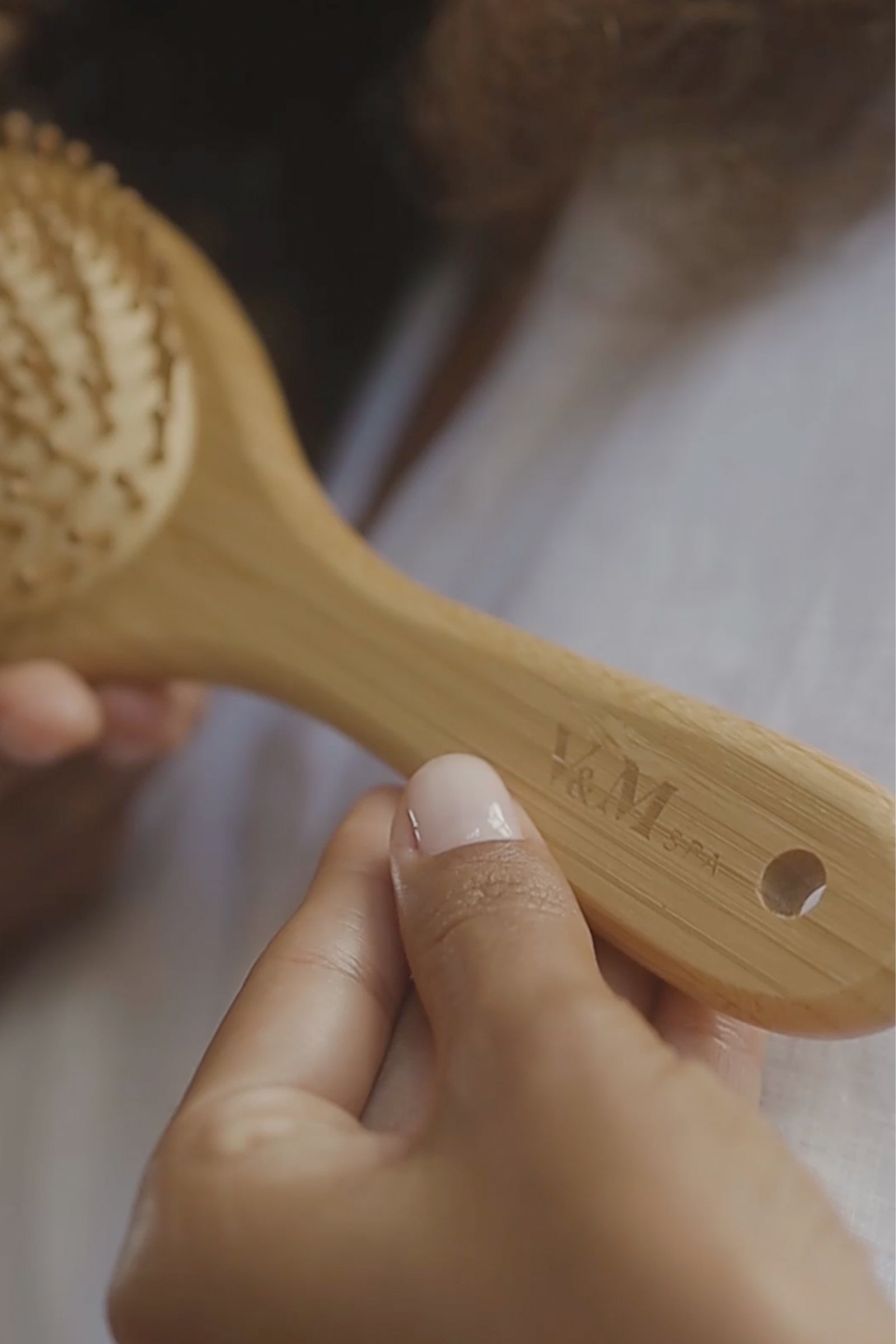
Modern hair care has trained us to respond immediately. A sensation appears, and we act. Washing less asks for a different kind of attention.
Confidence grows when we learn to distinguish between:
Discomfort caused by imbalance, and
Unfamiliar sensations caused by change
An oily sensation does not necessarily indicate excess. Often, it signals redistribution. A flatter appearance can reflect reduced friction rather than loss of volume. Texture that feels inconsistent may be hair settling into a new equilibrium.
Observation without reaction is not passive. It is disciplined. Over time, the scalp rewards this restraint with predictability.
Why Consistency Matters More Than Optimisation
Once the initial uncertainty passes, a new temptation often appears: refinement.
At this stage, many people begin to optimise — introducing treatments, adjusting frequency, layering products, or seeking faster visible results. While refinement has its place, it is premature here.
Biological systems respond best to stability. Every unnecessary adjustment resets progress. Consistency allows small improvements to accumulate quietly, strengthening the scalp barrier and preserving hair integrity over time.
This is where results compound — not through intensity, but through repetition without disruption.
How Results Accumulate Over Time
Hair does not regenerate once it leaves the follicle. Every intervention leaves a mark. When washing frequency is reduced and consistency is maintained:
The cuticle experiences less mechanical stress
Natural oils better protect mid-lengths and ends
Breakage often reduces gradually
Scalp sensitivity continues to settle
These changes are rarely dramatic in isolation. Their power lies in accumulation. Weeks become months. Hair becomes more resilient. Cleanliness feels quieter, less performative.
This is the long view — the one most routines never allow.
Ritual as the Container for Time
Ritual provides structure when outcomes are not immediate.
Maintaining familiar gestures, consistent timing, and trusted formulations creates a sense of steadiness — not only for the scalp, but for the person caring for it. In this way, ritual becomes the structure that holds patience.
Ritual is not about control. It is about continuity.
When the same actions are repeated calmly over time, the scalp begins to trust the environment it is given. Hair responds not to novelty, but to reliability.
Staying the Course
Supporting the shift confidently is ultimately about resisting urgency.
There is no moment where balance announces itself. It arrives quietly — often noticed only in hindsight. Hair feels stronger. The scalp feels calmer. Washing becomes a choice rather than a compulsion.
At this stage, the work is simple:
Maintain rhythm
Observe without urgency
Allow results to compound naturally
Care reaches its most refined state when nothing more needs to be added.

Closing Reflection
Washing less is not a trend. It is a return to listening.
Consistency is not repetition for its own sake. It is what allows the body to finish what restraint begins. When given time, hair and scalp do not ask for more — they ask for less interference.
This is where confidence often settles, gradually and without announcement.
Research references
Guidance referenced in this article draws on dermatological and trichological research, including publications from the American Academy of Dermatology Association, the British Journal of Dermatology, and the International Journal of Trichology, with particular focus on scalp barrier recovery, sebum regulation, and cumulative hair fibre stress.